The Setter’s Work Before Volleyball’s Attack
Volleyball setter decisions turn a first contact into a readable attack, showing how pass quality, blockers and hitter options shape the next play.
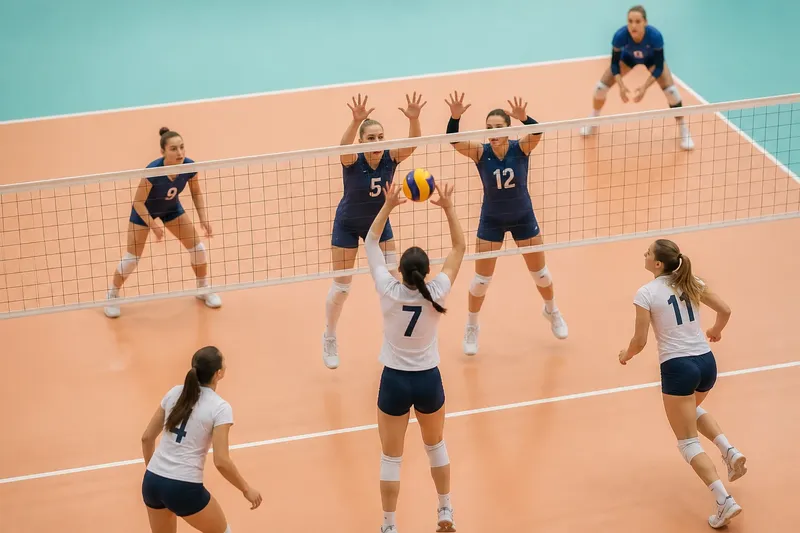
Volleyball setter decisions begin before the ball reaches the setter’s hands: the first contact, the opposing block and the available attackers already narrow the choices. Imagine a hypothetical rally in which a serve pulls the passer towards the sideline. The setter’s task is not simply to send the ball to a favourite hitter. It is to turn an imperfect start into an attack the team can still use.
This invented situation is a useful way to follow the role. We will track what the setter can see, which options remain, and how the choice changes the block’s job. The point is not to prescribe one perfect decision. It is to notice how a setter organises uncertainty for the attackers.
What arrives from the first contact?
In our imagined rally, the serving team sends a deep ball towards the seam between two receivers. One passer takes it, but the pass drifts away from the net and towards the left side of the court. The ball is playable, yet it is not the quick, close pass the setter would prefer.
That distinction matters because the setter’s choices depend on where the second contact can happen. A pass near the net may allow several fast options. A pass pushed off the net usually gives the setter less time and a narrower range of angles. The setter must also judge whether the ball is coming towards them, moving across their path, or likely to force them to chase.
In this scenario, the setter moves to the left of centre to reach the pass. The setter’s body position and hands matter to the eventual contact, but the tactical question comes first: which attackers can still be involved without making the ball difficult to control? A central quick attack may be less available than a high ball to an outside hitter. A back-row option may remain possible if that attacker has room and the team’s arrangement allows it.
The first contact therefore does more than keep the rally alive. It sets the menu. The setter reads that menu while the ball travels, rather than waiting until it is already time to choose.
Which clues shape the setter’s choice?
While moving towards the pass, the setter is gathering information from both sides of the net. Some clues concern the team’s own attack: who is approaching, which hitter has adjusted their run, and whether the middle attacker can still draw attention. Other clues come from the opponents: how many blockers are ready, where they are standing, and whether one has started moving early.
In our hypothetical rally, the middle blocker takes a small step towards the net as the pass drifts away. That movement could signal readiness to close on a quick set, or it could be an attempt to make the setter hesitate. The setter cannot know the blocker’s intention with certainty. They can, however, notice that the middle is no longer planted squarely between the two outside attacking lanes.
The setter also checks the state of the attackers. The left-side hitter is approaching from near the antenna, while the opposite hitter is available on the other side. A middle hitter starts forward, then slows when the pass makes the timing awkward. That adjustment is useful information: insisting on a fast middle set might leave the hitter reaching rather than attacking in rhythm.
These observations are not separate boxes to tick in a fixed order. They overlap as the setter tracks the ball. A useful analogy is choosing which door to open while carrying a tray: the nearest door may not be the easiest, and a person moving in the corridor can change the decision. The setter weighs the available route, the timing and the traffic at the net.
How does the setter keep more than one attack alive?
Before the setter contacts the ball, attackers can help preserve options by maintaining believable approaches. The middle hitter’s movement may make the opposing blocker account for a quick attack even if the pass makes that attack unlikely. The outside hitter can keep an approach balanced rather than stopping early. The opposite can remain ready for a set across the court.
In the invented rally, the middle hitter continues a short approach and holds the central blocker’s attention for a moment. The setter sees that the outside hitter is still moving towards the left antenna, while the opposite has space to attack from the right. The setter now has a choice between a higher, safer ball to the outside and a cross-court set to the opposite that could catch the block moving the wrong way.
Keeping options alive does not mean pretending every attack is equally available. It means avoiding an early signal that lets the block settle before the setter has made the choice. If the setter turns unmistakably towards one hitter too soon, or if the team’s approaches become predictable, the blockers may gain time to gather. The attackers’ movement and the setter’s composure work together to delay that certainty.
There is a limit, though. A setter should not preserve a deceptive look at the cost of a ball the hitter cannot reach. An attack that is technically available but badly timed may be a poorer choice than a clear, controlled set. The role is to coordinate what the team can realistically execute, not to make every rally look elaborate.
What happens in this hypothetical rally?
Suppose the setter reaches the drifting pass and judges that a quick set to the middle would arrive too late. The setter sees the central blocker leaning in, the outside hitter still approaching, and the opposite available on the far side. The setter chooses a high ball to the outside hitter, away from the net enough to give that hitter room to approach.
The set is not a dramatic trick. Its value is that it preserves a workable attack after a pass that removed the fastest option. The middle hitter’s brief approach has occupied the central blocker, and the opposite’s presence means the defence cannot ignore the far side throughout the play. The outside hitter now faces a block that must still organise itself, rather than one that has been waiting comfortably in place.
For the imagined outcome, say the outside hitter sees one blocker closing and another arriving late. The hitter chooses a controlled shot into open court instead of forcing a hard swing through the block. The ball lands before a defender can cover it, and the rally ends. This is an invented result, not a claim that the same choice will score in every match. It shows how a setter’s earlier decision can improve the hitter’s options without deciding the point alone.
Now change one detail. If the outside hitter had been held back by the pass, while the opposite had a clear approach and the block was still drifting left, setting the opposite could have offered the better attack. If both hitters were out of rhythm, a high ball to the most reliable available attacker might be sensible even if the block could read it. The setter is choosing among imperfect routes, not solving a puzzle with one fixed answer.
Why might a setter choose the safer-looking ball?
A set that looks predictable can still be tactically sound. If the pass is far from the net, the setter may prioritise height and space so the hitter can approach under control. A lower, faster set may give the blocker less time if it arrives cleanly, but it also leaves less margin when the setter is chasing the ball or the hitter’s timing is disrupted.
Score, rotation and team strengths can also affect the choice. A team may have a dependable outside hitter in the front row, or a back-row attacker available to widen the options. The setter must respect the rotation and the team’s attacking arrangement; they cannot simply choose the most appealing player regardless of where that player is or what the rules permit.
There is also value in a choice that keeps the team in a good position for the next contact. A controlled attack may be dug, but if it makes the defence move and the blockers land awkwardly, the attacking team may still have a chance to continue. The setter’s work is not limited to producing a clean kill. It includes giving the team a useful route through the rally.
What do readers often ask about the setter’s decisions?
Does the setter always take the second contact?
The setter usually organises the second contact, but the rally may force another player to set if the setter takes the first ball or cannot reach it. Teams practise for those moments so that a disrupted contact does not automatically end the attack.
Why not set the tallest or strongest hitter every time?
The best option depends on the pass, the hitter’s approach, the block and the available space. A powerful hitter facing a well-formed block may have fewer useful choices than a less obvious attacker with a cleaner route.
Can the setter see the blockers while tracking the pass?
The setter develops awareness of the net and opposing movement while following the ball, though the view and timing change from play to play. The decision is based on clues gathered before and during the move to the ball, not on a perfect view of everything at once.
Is a high outside set a failure of the planned play?
Not necessarily. If the pass has disrupted the original timing, a higher outside ball may be the most practical way to give an attacker room and keep the rally organised. The quality of the choice depends on how well it fits the situation, not on whether it was the first option imagined.
What should a viewer watch for next time?
Watch the setter before the ball arrives, not just at the moment of contact. Notice whether the pass pulls them away from the net, whether the middle hitter keeps moving, and whether an opposing blocker shifts early. Those details explain why the final set goes to one hitter rather than another.
Then watch what the setter leaves open. A middle approach may be there to draw attention; an outside hitter may continue moving to preserve a high-ball option; an opposite may stay ready in case the defence overcommits. The attack is shaped by these choices even when the ball eventually goes to the player most people expected.
Volleyball setter decisions are best understood as choices made under changing conditions, not as a simple delivery to the next hitter. In the imagined rally, a drifting pass removed the quick middle attack, but the setter still created a useful outside chance by reading the block and keeping other attackers credible. Next time a set looks obvious, look one beat earlier: the setter may already have changed what the defence is able to cover.