Why Tennis Matches Use Tiebreaks
Why tennis matches use tiebreaks: see how the format settles a level set, limits open-ended games and makes the closing stretch easier to follow.
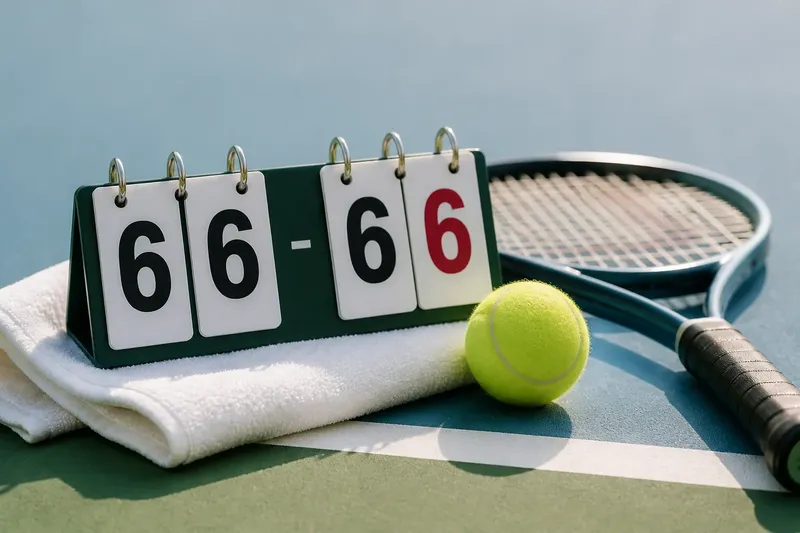
Why tennis matches use tiebreaks becomes clear when a set reaches six games apiece: ordinary games have not separated the players, so a set rule must decide what happens next. The tiebreak supplies that rule, turning a level score into a defined contest while preserving tennis’s point-by-point pressure.
What problem does a tiebreak solve?
Most sets are built around a two-game margin. A player who reaches six games with at least two more than the opponent takes the set; a score such as 6–4 is settled without extra play. At 6–5, though, the trailing player can level the set at 6–6. Under a traditional advantage-set format, play then continues until someone leads by two games.
That can produce a long, uncertain finish. A player may hold serve repeatedly, with each new game keeping the set alive. The rallying remains meaningful, but the format offers no nearby stopping point. A tiebreak changes the decision from “win two more games clear” to “win a separate, countable contest”.
Think of it like a kitchen timer used to settle a shared turn: it does not decide who played better earlier, but it gives the remaining dispute a clear boundary. In tennis, the tiebreak is still tennis, with serves, rallies and pressure, but the scoring changes for this final stretch.
How does a standard tiebreak work?
In the familiar first-to-seven format, a player must reach at least seven points and lead by two. If the score reaches 6–6, play continues until that two-point gap appears. So 7–6 is not enough to finish; 8–6 is. The same logic applies if the contest runs longer.
Players alternate service in a set pattern rather than taking a whole service game each. One player serves the opening point, then the other serves the next two, and service continues in pairs. Players also change ends at regular intervals during the tiebreak, which helps distribute the effects of sun, wind or court conditions.
The set score is usually recorded as 7–6 for the winner, with the tiebreak points often shown in brackets. That notation tells a reader both that the set reached six games each and how the deciding contest ended. The tiebreak score is not another game score; it is a separate point total used to settle the set.
Why can the deciding format vary?
Not every tiebreak has the same target. Some competitions use a first-to-ten match tiebreak in place of a full deciding set, again requiring a two-point margin. This saves a set while preserving a substantial final contest. Other events use a tiebreak at 6–6 in the final set, while some formats have historically allowed that set to continue until one player leads by two games.
These choices shape the match’s likely rhythm. A tiebreak at 6–6 means players know a set has a defined endpoint once it reaches that score. A match tiebreak replacing a deciding set makes the final phase shorter in structure, but each point can carry unusual weight because it directly advances the match decision.
For a particular tournament, check its format rules: the tiebreak target and its place in the match can differ, and the event’s published rules are the authority. The broad principle remains easy to spot: a tiebreak sets a point-based route to a result where the usual game margin has not produced one.
What should you watch as a tiebreak begins?
Follow the score and the serve pattern together. A player who serves the first point does not keep serving for the next two, so the sequence can affect how spectators read momentum. Also notice the two-point requirement: reaching the target number is only a threshold, not an automatic win.
Imagine a set reaches 6–6 after each player has held serve through a tense run of games. In a standard tiebreak, one player takes an early lead, but the other draws level at 6–6 in points. The contest is still live; if the first player wins the next two points, the score becomes 8–6 and the set is decided. If they split those points, play continues.
That sequence explains why a tiebreak can feel both compact and suspenseful. The finish is bounded by a clear format, but there is no fixed final point unless a two-point lead arrives. A small lead can disappear, and a player who falls behind still has a route back.
What do readers often ask about tennis tiebreaks?
Does every set use a tiebreak?
No. Many formats use one when a set reaches 6–6, but the rules of the competition determine whether that applies to every set, only certain sets or none. A set may instead continue until a player leads by two games.
Why must a player win by two points?
The margin prevents a tie at the target from ending the contest. If both players reach the threshold level, they continue until one has a two-point advantage, giving the format a definite result rather than a shared score.
Is a match tiebreak the same as a set tiebreak?
They use a similar point-scoring idea, but serve different roles. A set tiebreak settles a set that has reached a specified game score, while a match tiebreak may replace a whole deciding set under that competition’s format.
Why does the service order change?
The alternating pattern shares service opportunities rather than leaving one player to serve every point. The opening server takes one point, then the other player serves two at a time, making the sequence easier to track as the pressure builds.
How does the tiebreak shape the match?
A tiebreak does not erase the games that came before it. Those games establish the level score and decide who reaches the final contest; the tiebreak then applies a different scoring frame to settle the set. It gives players and spectators a clear change of phase without pretending that every point has identical context.
Next time a set reaches 6–6, read the event’s format, watch the service sequence and keep the two-point margin in view. That is the simplest way to understand why tennis matches use tiebreaks: the format turns a set that could otherwise keep extending into a contest with a visible route to resolution.